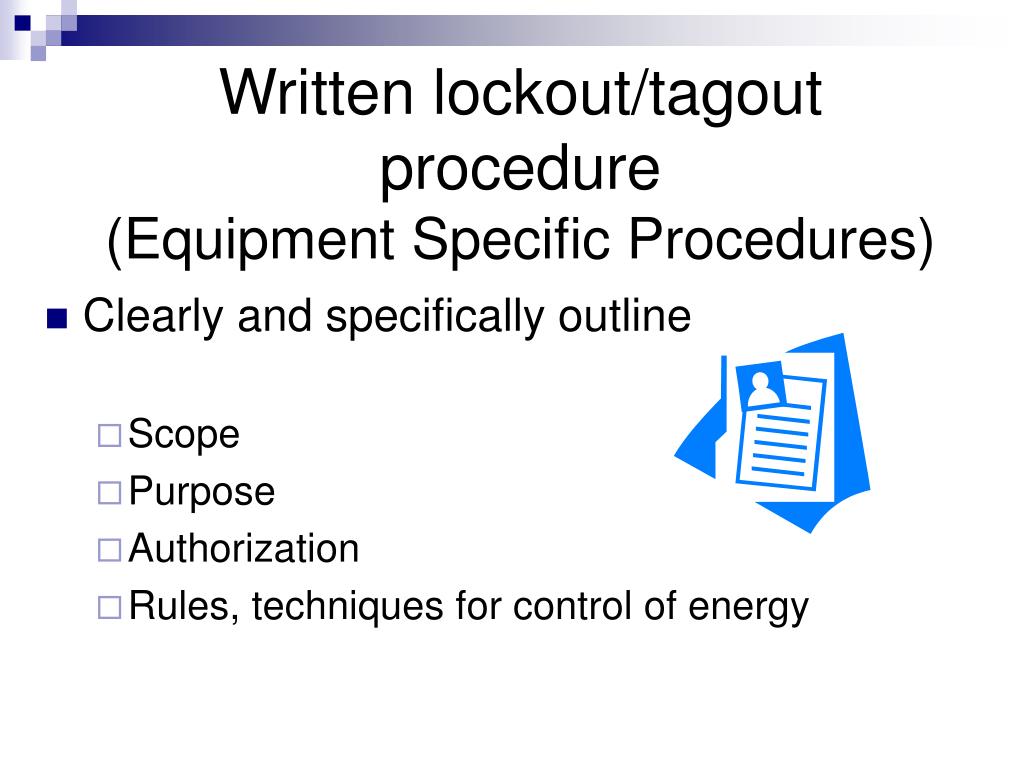
Every year, hundreds of workers suffer serious injuries—or worse—during equipment servicing because energy sources weren’t properly controlled. The fix isn’t complicated, but it must be consistent: a well-documented, clearly understood lockout tagout written procedure.
Without one, even experienced maintenance teams operate at risk. A written LOTO procedure isn’t just paperwork—it’s a legal requirement under OSHA 1910.147 and the backbone of any serious safety program. It turns assumptions into actions and guesswork into guaranteed protection.
This guide details what a compliant, effective lockout tagout written procedure must include, how to build one that works in real-world conditions, and common pitfalls that undermine even the best-intentioned programs.
Why a Written LOTO Procedure Is Non-Negotiable
Verbal instructions or memory-based processes fail under pressure. Stress, fatigue, or time constraints cause workers to skip steps. A written lockout tagout procedure eliminates ambiguity.
OSHA doesn’t accept “we’ve always done it this way” as justification. The standard explicitly requires that “The employer shall establish a written energy control program” (1910.147(c)(4)). That program must include documented procedures for each machine or piece of equipment.
But compliance is just the baseline. A strong written procedure:
- Reduces human error during maintenance
- Serves as legal documentation during inspections
- Provides a training foundation for new employees
- Clarifies roles and responsibilities
- Supports incident investigations
Without it, your team is exposed—not just to energy hazards, but liability.
Core Elements of an Effective Written LOTO Procedure
A boilerplate template won’t cut it. Each procedure must be specific to the equipment and energy sources involved. That said, every compliant LOTO document should include these essential sections.
1. Equipment Identification
Clearly name and describe the machine. Include make, model, location, and a unique identifier (e.g., asset number). Use photos or diagrams if helpful.
Example: “Conveyor System A – Packaging Line, West Facility. Asset #CV-304. Manufacturer: FlexiConveyor Inc., Model X7.”
2. Energy Type Identification
List all energy sources that must be controlled:
- Electrical (main disconnect, control circuits)
- Hydraulic (reservoirs, accumulators)
- Pneumatic (compressed air lines, tanks)
- Mechanical (springs, gravity-fed systems)
- Chemical (pressurized tanks, gas lines)
- Thermal (steam lines, heated surfaces)
Don’t overlook stored energy. A hydraulic cylinder under pressure or a flywheel that retains motion can be just as deadly as live electricity.
3. Shutdown Steps
Detail the sequence for safely shutting down the machine before lockout begins. This is often the first place where shortcuts happen.
- Example:
- Notify operations supervisor
- Press emergency stop button
- Allow machine to come to complete stop
- Close isolation valves on hydraulic supply
4. Isolation Points
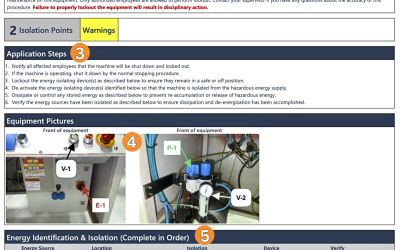
Identify the exact energy-isolating devices (EIDs) to be locked out. Include lockout device type (e.g., hasp, circuit breaker lock, valve lock).
Example: - Main power disconnect: 480V, located panel P-12 - Hydraulic isolation valve: DN50, near base of machine - Pneumatic shutoff: Ball valve, line A-7
Use a lockout station map or schematic if the machine has multiple isolation points.
5. Application of Locks and Tags
Specify who applies each lock, what kind of lock is used, and where tags are placed. Include personal lock policy: each authorized employee applies their own lock.
Example: - Maintenance Tech A applies padlock #MTA-01 to main disconnect - Tag includes: “Do Not Operate – Equipment Under Maintenance – John Doe, 8:15 AM” - Supervisor verifies all locks in place before work begins
6. Release and Verification
Outline how to confirm zero energy state. This is a critical step often rushed or skipped.
Procedures should require:
- Use of voltage tester on electrical circuits
- Bleed-off checks for hydraulic/pneumatic lines
- Physical inspection of moving parts
Only after verification should maintenance begin.
7. Restoration Steps
Re-energizing equipment is just as dangerous as shutting it down. The procedure must detail:
- Removal of tools and guards replacement
- Clearing the area of personnel
- Sequential removal of locks (only by the person who applied them)
- Notification to operations team
- Controlled startup
Never allow group lockout removal without verification from each individual.
Common Mistakes That Undermine LOTO Procedures
Even workplaces with written procedures often fall short due to preventable errors.
Vague or Generic Language
Phrases like “shut off power” or “lock out machine” lack precision. What power? Where? Which lockout point?
Fix: Use exact terminology and locations. “Open and lock out breaker #5 in Panel B-2” leaves no room for error.
One Procedure for Multiple Machines
A single LOTO process for “all conveyors” won’t suffice. Each machine has unique energy sources and shutdown sequences.
Fix: Create individual procedures for each distinct piece of equipment, even if they appear similar.
Missing Stored Energy Controls
Workers lock out the main power but forget a spring-loaded arm or pressurized line. These hidden hazards cause many accidents.
Fix: Conduct an energy audit for each machine. Include bleed-down, blockage, or draining steps in the procedure.
Poor Accessibility
If the written procedure is buried in a binder or saved on a locked server, it’s useless during an emergency.
Fix: Keep printed copies at or near the equipment. Use laminated quick-reference cards if needed.
Infrequent Review and Updates
A LOTO procedure written five years ago may not reflect current equipment modifications.
Fix: Review all procedures annually or after any machine change. Document revisions and retrain staff.
How to Write a LOTO Procedure: A Step-by-Step Workflow
Creating a robust written procedure doesn’t have to be complicated. Follow this workflow:
- Select the Equipment
- Begin with high-risk or frequently serviced machines.
- Conduct an Energy Audit
- With maintenance and operations teams, identify every energy source and isolation point.
- Map the Shutdown Sequence
- Walk through the process with a technician. Document each action in order.
- Draft the Procedure
- Use clear, imperative language. “Close valve,” not “The valve should be closed.”
- Include Visuals
- Add labeled diagrams, photos, or flowcharts where helpful.
- Review with Stakeholders
- Get input from safety officers, maintenance leads, and operators.
- Train and Test
- Conduct a live drill using the procedure. Time it, observe gaps, refine.
- Approve and Publish
- Assign a version number and approval date. Store in an accessible format.
Repeat this for each critical machine. Prioritize based on injury risk, frequency of servicing, and energy complexity.
Group Lockout Procedures: Special Considerations When multiple workers service one machine, a group lockout adds complexity. A written procedure must include:
- Designation of a primary authorized employee (often the lead technician)
- Use of a group lockbox
- Each worker applies their personal lock to the box
- The box contains keys or hasps controlling individual energy points
- No energy restoration until all personal locks are removed
Example scenario: A press requires electrical, hydraulic, and mechanical servicing. Three technicians each apply their lock to the group lockbox. The primary technician verifies all work is complete and ensures each person removes their lock before re-energizing.
Without a written group LOTO process, coordination breaks down—and someone may restart equipment prematurely.
Real-World Example: LOTO Procedure for a CNC Machine

Equipment: CNC Milling Machine – Model ProCut 5000, Station #3 Location: Machining Bay B, Floor 2 Authorized Personnel Only
Energy Sources: - Electrical: 3-phase, 480V main disconnect - Pneumatic: Compressed air line (120 psi) - Mechanical: Spindle inertia, tool changer
- Shutdown Steps:
- Complete current operation and retract tool.
- Press “Cycle Stop,” then “Power Off” on control panel.
- Wait 60 seconds for spindle to stop completely.
Isolation Points: - Main disconnect: Breaker #MC3, Panel P-5 - Air supply: Ball valve V-12, near machine base
Lockout Application: - Each technician applies personal lock to breaker and air valve. - Tags must include name, time, and reason.
Verification: - Test for voltage using approved meter. - Open bleed valve on air line; confirm pressure gauge reads zero. - Visually confirm spindle is stationary.
- Restoration:
- Confirm all tools removed and guards replaced.
- Each technician removes their lock.
- Notify supervisor.
- Restore air supply, then power.
- Perform test run at low speed.
This level of detail ensures every action is intentional and safe.
Digital Tools to Manage LOTO Procedures
Paper binders work, but digital systems improve accessibility, tracking, and compliance.
Top Platforms for Managing Lockout Tagout Procedures:
| Tool | Key Features | Best For |
|---|---|---|
| SafetyCulture (iAuditor) | Mobile checklists, photo documentation, real-time reporting | Field teams needing fast audits and updates |
| Lockout Tagout Pro | Built-in templates, lock tracking, employee training logs | Medium to large facilities with complex equipment |
| EHS Insight | Full EHS suite with LOTO module, audit trails, compliance alerts | Enterprises requiring integration with safety management |
| Failsafe LOTO | Cloud-based procedures, QR code access at machines, digital sign-offs | High-turnover environments needing quick training |
| MasterControl EH&S | Automated workflows, document control, version tracking | Regulated industries (pharma, aerospace) |
These tools help ensure procedures are up to date, accessible, and consistently followed.
A lockout tagout written procedure isn’t just a document—it’s a promise. A promise that no worker will be harmed because a machine unexpectedly started up. That promise only holds if the procedure is specific, accessible, and lived every day.
Start by auditing your highest-risk equipment. Build detailed, actionable procedures. Train, test, and revise. Then scale across your operation.
The cost of a single preventable accident far outweighs the effort of writing a few pages. Make your LOTO procedures real, usable, and non-negotiable—because safety isn’t optional.
FAQ
What is a lockout tagout written procedure? A documented step-by-step process that outlines how to safely shut down, isolate, lock out, and verify the de-energization of equipment before maintenance.
Is a written LOTO procedure required by OSHA? Yes. OSHA 1910.147(c)(4) mandates that employers establish a written energy control program, including specific procedures for each machine.
Who writes the LOTO procedure? Typically, a safety manager or qualified engineer works with maintenance and operations staff to develop the procedure based on equipment design and energy sources.
How detailed should a LOTO procedure be? It must be machine-specific, list all energy types, identify exact isolation points, and include shutdown, lockout, verification, and restart steps.
Can one procedure cover multiple machines? Only if the machines are identical in energy sources and isolation methods. Generally, each unique machine requires its own procedure.
How often should LOTO procedures be reviewed? At least annually, or whenever equipment is modified, repaired, or involved in an incident.
What’s the difference between lockout and tagout? Lockout physically prevents energy restoration (e.g., a padlock on a breaker). Tagout uses a warning tag but doesn’t provide physical restraint—less secure and only allowed under specific conditions.
FAQ
What should you look for in Lockout Tagout Written Procedure: A Complete Guide? Focus on relevance, practical value, and how well the solution matches real user intent.
Is Lockout Tagout Written Procedure: A Complete Guide suitable for beginners? That depends on the workflow, but a clear step-by-step approach usually makes it easier to start.
How do you compare options around Lockout Tagout Written Procedure: A Complete Guide? Compare features, trust signals, limitations, pricing, and ease of implementation.
What mistakes should you avoid? Avoid generic choices, weak validation, and decisions based only on marketing claims.
What is the next best step? Shortlist the most relevant options, validate them quickly, and refine from real-world results.